Watch Episode 7 first:
*By Billy Bohan Chinique, Vice President, Marketing & Digital Innovation
Watch it before reading — Herb’s beach walk in particular needs to be seen, not summarized. I’ll wait.
We made it to the final port of the series, and I want to be upfront about something before we get into it: out of every stop on this entire voyage, this is the one I’d call the most meaningful. Not the biggest thrill (though wait until you hear about the zip line), not the most dramatic scenery (Hubbard still holds that crown in my heart forever) — the most meaningful, because of what the port itself represents.
Icy Strait Point is the only privately owned cruise port in Alaska, and it isn’t privately owned in the generic corporate sense. It belongs to the Huna Tlingit community of Hoonah, the nearby town whose residents built this destination themselves out of a piece of their own industrial history.
Quick crew note: Michelle Bentubo, Chief Operations Officer at Virgin Voyages, wasn’t with me for this one — she’d headed off to film aboard Valiant Lady, so I had a new co-host for the day: Kathy Boos, Virgin Voyages’ Head of Creative Production. Different energy, still an incredible day, and honestly it gave the episode a slightly fresh perspective going into the final stop.
What You’ll See in This Episode
The day is anchored by Herb, the onboard heritage guide who sails the entire voyage and who happens to trace his own family back generations on this exact beach. Herb walked us along the shoreline and explained how the Huna people came to settle in Hoonah after being forced out of Glacier Bay by an advancing glacier — a piece of history that connects directly back to the geological forces we explored earlier in the series at Hubbard Glacier. I did not expect this series to loop back on itself thematically like that, and it genuinely got me.
From there, the episode splits into two headline Shore Things: the world’s largest ZipRider, launching from the top of White Alice Mountain, and whale watching at Point Adolphus, paired with a waterfront seafood feast. Woven throughout both is a visit to the freshly carved Warrior Totem Poles, honoring veterans, aunties, and grandmothers, and the community-ownership story that makes this entire destination possible.
Behind the Scenes: A Cannery That Became a Town’s Second Chance
This is the story I think deserves the most attention out of anything in this final episode. Icy Strait Point sits on the site of a salmon cannery originally built on Native land and worked by Native labor — and then, like so many industrial operations in remote Alaska, eventually abandoned by its outside owners once it stopped being profitable for them.
In 1996, the Huna Totem Corporation bought that shuttered cannery. Rather than letting it sit as a relic or selling it off piecemeal, the community rebuilt it into Icy Strait Point — a destination where every dollar generated goes back into Hoonah, and where 85% of the staff actually live in the community they’re welcoming Sailors into. That’s not a footnote detail; it’s the entire architecture of the place. This is economic sovereignty that visibly works, built on the site of an operation that once extracted value from this land and labor without returning much of it.
I spent time filming the freshly carved Warrior Poles as part of this story — poles honoring veterans, aunties, and grandmothers, roughly five months in the making, which we were invited to bless with a hand placed directly on the wood. It’s a small ritual, but it captures something the whole episode is trying to say: this is a living community continuing to add to its own story, not a museum preserving a static one.
The Experience Everyone’s Going to Ask You About: The World’s Largest ZipRider
Once you get past the community story, the activity most people will want to know about is the ZipRider — and it earns the hype completely. We rode the Sky Peak Gondola up White Alice, also known as Hoonah Mountain, for sweeping views across Icy Strait and toward Glacier Bay, before launching from 1,330 feet on the world’s largest ZipRider: 5,495 feet of cable across six side-by-side lines, reaching speeds up to 60 mph on the way down to a sea-level Drop Zone.
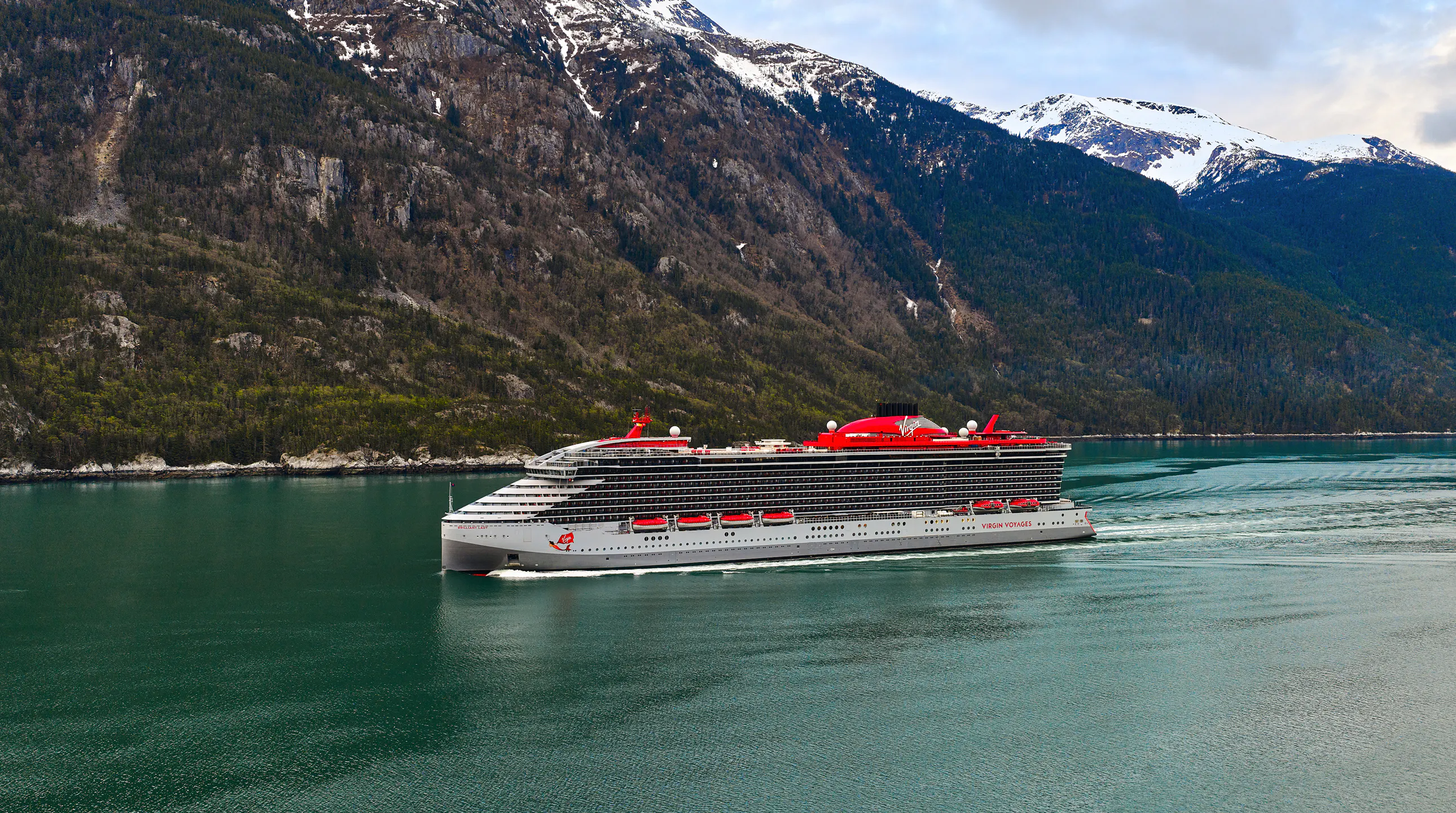
One detail I loved uncovering on camera: the zip line itself was actually built back in the winter of 2006–2007, under conditions that included roughly 26 feet of snow at the site — the gondola came later, meaning the line predates the easier access most visitors take for granted today. Riding it down, the views frame the surrounding islands, the open ocean, and the ship itself in a single sweeping sequence, which made for some of the best footage in the entire series — honestly, it might be the most beautiful you’ll ever see Brilliant Lady look, framed against the islands and open water below.
Good to know: the ZipRider runs about 1.5 hours and isn’t wheelchair accessible; not recommended for anyone with a fear of heights or vertigo, or anyone who is pregnant or has back or neck injuries. Includes unlimited gondola rides, a signature “Zip Drop Shot” at the bottom, a souvenir shot glass, and a copy of the GoPro video (cameras are provided — you don’t need to bring your own). Dress warmly and waterproof with sturdy shoes.
Whales & Wild Feast: The Other Half of the Day
For Sailors who’d rather skip the zip line, or want to do both across your group, Point Adolphus offers some of the richest whale-watching waters on the entire itinerary — home to the largest humpback population in Alaska, with orcas frequently in the area too. This pairs the whale watching with a waterfront crab-and-shrimp boil featuring Southern-style seasoning, sausage, and corn, followed by marshmallows roasted at a fire pit overlooking Port Frederick.
It’s genuinely two quintessential Alaska experiences — significant wildlife and a proper feast — packed into a single half-day, and it’s exactly the alternative several people in our own filming group chose while the rest of us went zipping.
Good to know: runs about 3.5 hours and starts from $295. Accessible for collapsible wheelchairs if Sailors can manage a few steps, though wheelchair access should be arranged 72 hours ahead. Whale sightings are guaranteed, or your money back. One beverage included; dietary restrictions and allergies unfortunately can’t be accommodated, so plan accordingly, and take motion-sickness precautions given time spent on open water. Dress in warm, waterproof layers.
Why Community Ownership Changes How a Place Feels
I’ve filmed plenty of tourist destinations built and operated by outside corporations, and there’s often a subtle but detectable quality to those places — a sense that the destination exists primarily to extract value from visitors passing through, with limited connection to whatever community happens to surround it. Icy Strait Point felt different from the moment we arrived, and I spent a good chunk of this episode trying to understand why.
The answer, I think, comes down to incentive alignment. When 85% of the staff live in the community that owns the destination, and every dollar generated returns to that same community, the economic incentives point toward long-term stewardship rather than short-term extraction. That shows up in small, hard-to-fake details — the genuine warmth of interactions with locals, the visible investment in projects like the Warrior Totem Poles that have no direct commercial return, the willingness of guides like Herb to spend unhurried time on family history rather than rushing through a script.
I don’t think every destination needs to replicate this exact ownership model to be worthwhile, but I do think it’s worth understanding, because it changes what your visit actually supports. Money spent at Icy Strait Point is, in a very direct sense, money invested in Hoonah’s continued existence as a community, not just a transaction with a corporate operator.
Rookie vs. Ten-Timer (Sort Of): Kathy Edition
Since Michelle wasn’t with me for this one, the “rookie versus expert” dynamic shifted a bit. Kathy stepped in as co-host for the day. She was the one who made sure we approached Herb’s beach walk and the Warrior Totem Poles with the right amount of care instead of just treating it as B-roll. I’m genuinely grateful she was there for this specific episode, because I don’t think I would’ve known to slow down the way this stop deserved without her steering the day.
Practical Tips for an Icy Strait Point Day Ashore
- Choose your headline activity based on what kind of “big” you want to end your trip on. ZipRider for adrenaline, Whales & Wild Feast for wildlife and food.
- Don’t treat Herb’s beach walk as optional if it’s offered during your visit. Of everything across this entire series, this is a moment I’d tell you not to rush past.
- Budget time to actually engage with the community’s own story, not just the activities. The Warrior Totem Poles and the Huna Totem Corporation history aren’t separate from the “fun” parts of the day — they’re the context that makes everything else feel like part of something larger.
- If arranging wheelchair access for Whales & Wild Feast, plan 72 hours ahead.
Closing Thoughts on the Whole Series
Filming this series across seven ports, from the Inside Passage’s opening stillness to Icy Strait Point’s closing zip line, gave me a version of Alaska I genuinely did not expect going in, even after twenty years of hearing about this place from colleagues who’d been. I knew the landscapes would be dramatic — that part was never in question. What surprised me was how consistently the human stories underneath the landscapes turned out to be just as compelling: a fishing captain who built his business around genuine access rather than staged spectacle, a Tlingit community sharing ten thousand years of history inside a clan house, a sustainability lead who spent two years preparing a cruise line to operate responsibly in fragile waters, and a Native corporation that turned an abandoned cannery into a thriving, community-owned destination.
And Hubbard Glacier. I know I’ve said it in that episode already, but I’ll say it here one more time because this is the closing post of the series and it deserves to be said again: that’s the moment I will never, ever forget. Everything else on this trip was incredible. That was different.
If there’s one thing I want anyone reading this whole series to take away, it’s that Alaska rewards attention in both directions — outward, toward the glaciers and the wildlife, and inward, toward the people whose histories and livelihoods are woven into every port along the way.
One Last Thing About Herb
I want to give Herb his own paragraph, separate from the rest of the recap, because I don’t think I’ve fully done him justice yet. This is a person whose family history on that specific beach goes back generations, and he chose to spend his career sailing this itinerary over and over, telling that story to strangers who are only passing through for a few hours. Small detail I only learned after we wrapped: the onboard heritage guide we introduced back in Episode 1, the one who sails the whole voyage, is actually Herb’s son. Same family, same story, two different ways of carrying it. That’s a specific kind of generosity I don’t think I fully appreciated until I was standing next to him listening to it firsthand. Twenty years in this industry, and Herb is one of maybe five people I’ve met on the job who genuinely changed how I think about what “hospitality” actually means.
Pro Tips From Me
- Bring binoculars regardless of which excursion you book — eagles, bears, and whales are genuinely everywhere at Icy Strait Point.
- Split your group between the ZipRider and Whales & Wild Feast if you can’t decide — comparing notes afterward is half the fun.
- Check in on the Warrior Totem Poles if they’re accessible during your visit — quieter than the ZipRider, but one of the most genuinely moving parts of the whole port.
- If this is your last port like it was mine, don’t rush it just because the trip’s ending. Let it land.
Catch you on the flip — for real this time, that’s a wrap on the series.
Ready to plan your own Alaska voyage? Explore Virgin Voyages Alaska itineraries.